How to get to and get around the Winter Olympics in Italy (flights, trains and more)

Attending the Milano–Cortina 2026 Winter Olympics will be an unforgettable experience — but with events spread across more than 8,500 square miles of Northern Italy, these Games will also be the most geographically dispersed Olympics ever held.
That means smart travel planning is essential. If you don’t map out how you’ll get around the Winter Olympics in Italy, your once-in-a-lifetime trip could turn into a logistical challenge.
.

In a hurry? Book your essentials:
Rent a car (then use Park & Ride)
Private Transfers (door to door & airport)
Stay at (based on your tickets):
Milan: NH Milano Fiera
Cortina d’Ampezzo: Sport Hotel Wildgall
Val di Fiemme: Hotel Orso Grigio
Valtellina: Eden Hotel
Verona: Relais Balcone di Giulietta
Since events are spread all across northern Italy, getting between venues isn’t always quick nor easy. Travel times range from one to six hours depending on your route.
To make the most of your trip, plan your arrival airport carefully, arrange reliable ground transport, and pick accommodation close to your chosen events.
Where are the 2026 Winter Olympics held?
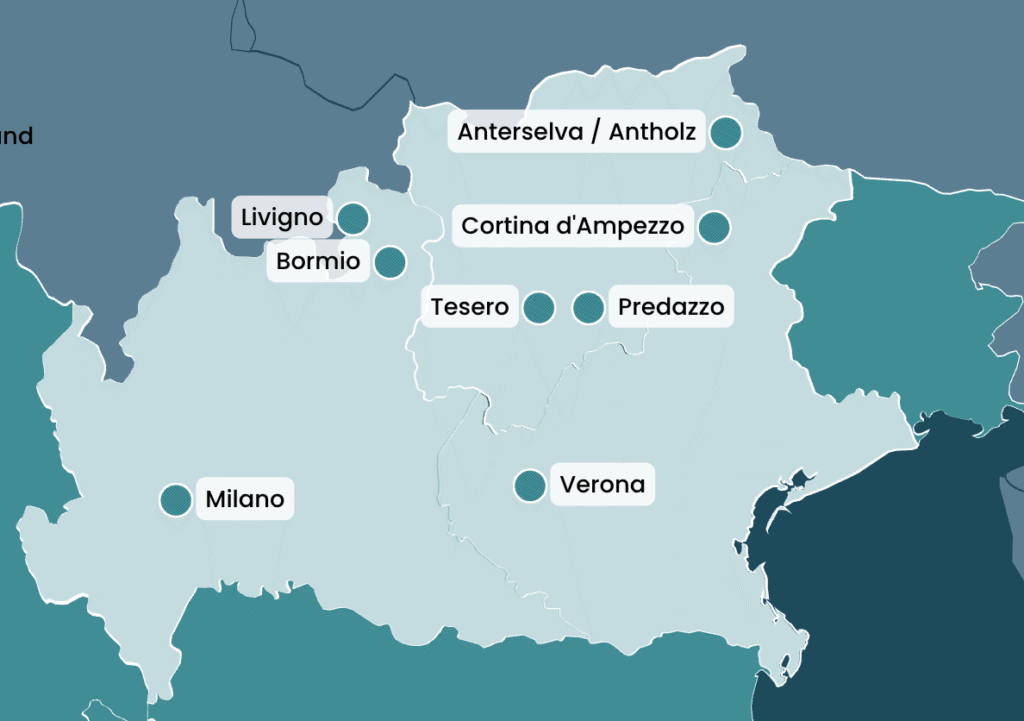
The Milano–Cortina 2026 Winter Olympics will take place across five main venue clusters, stretching from Milan to the heart of the Dolomites.
Each area hosts different events and has its own optimal airports and transport connections.
| Venue Cluster | Main Events | Best Airports | Notes / Tips |
|---|---|---|---|
| Milan | Opening Ceremony, Ice Hockey, Figure Skating, Speed Skating | Malpensa (MXP) Linate (LIN) | Central gateway for most international arrivals |
| Cortina d’Ampezzo & Anterselva (Dolomites) | Women’s Alpine Skiing, Bobsleigh, Skeleton, Luge, Curling, Biathlon | Venice (VCE) Treviso (TSF) Innsbruck (INN) | Most scenic cluster; plan transfers early due to limited direct transport |
| Val di Fiemme (Tesero & Predazzo) | Cross-Country Skiing, Ski Jumping, Nordic Combined | Verona (VRN) Venice (VCE) | Well connected via regional trains and highways |
| Valtellina (Livigno & Bormio) | Freestyle Skiing, Snowboarding, Men’s Alpine Skiing, Ski Mountaineering | Malpensa (MXP), Bergamo (BGY), Linate (LIN) | Reached via scenic Alpine routes or regional trains to Tirano |
| Verona | Closing Ceremony | Verona (VRN), or train from Milan/Venice | Convenient departure point for flights home |


How to plan your Winter Games 2026 Visit and Transport
The single question that should guide your planning is simple:
Which events do you want to watch live?
- Map your must-see events first. Buy tickets within only one zone on any given day. Travel times are considerable!
- Anchor stays around event blocks. Example: 4 days Milan (ice sports) → train to Val di Fiemme for Nordic finals → finish in Verona for the closing ceremony.
- Book in advance. Lock rooms and rental cars now, tweak later as event times firm up.
- Factor transit fatigue. One alpine transfer mid-trip is fun; doing Milan–Cortina round-trips each day is misery.
Plan cluster-by-cluster and book your Italy winter Olympic transport and accommodation fast. This way you’ll spend your energy cheering podiums instead of chasing buses through the Dolomites.
Flying to Italy for the Winter Olympics
Getting to the Milano-Cortina Games isn’t as simple as flying into one city and hopping on the metro; events are scattered across alpine valleys up to 400 km apart. Adequate planning is crucial!
Flights funnel through (mainly) Milan, Venice, and Verona, trains reach the foothills, and the rest of the journey relies on buses, Park-and-Ride lots, and dedicated Olympic shuttles.
The quick guide below gives you a quick overview of the best airports to fly to.
| Airport | About | To Cortina | To Milan | Book your transfer |
|---|---|---|---|---|
| Malpensa (MXP) | Major Italian Airport | ~4–5 hr | ~1 hr | Shuttle to Milan Private Transfer to Milan Private Transfers |
| Linate (LIN) | European flights to Milan | ~4–5 hr | ~0.5 hr | Private Transfer to Milan Private Transfers |
| Bergamo (BGY) | Ryanair & Wizz Air Base | ~4–5 hr | ~1 hr | Shuttle to Milan Private Transfer to Cortina Private Transfers |
| Venice Marco Polo (VCE) | Closest to Cortina d’Ampezzo | ~2.5 hr | ~3 hr | Private Transfer to Cortina Coach to Cortina Private Transfers |
| Treviso (TSF) | low-cost carriers | ~2.5 hr | ~3 hr | Private Transfers |
| Verona (VRN) | Closing ceremony, high‑speed trains to Milan and Venice | ~3 hr | ~1.5 hr | Private Transfers |
| Rome (FCO) | Major Italian Airport, high‑speed trains to Milan and Venice | ~8–9 hr | ~3–4 hr | Private Transfers |
| Innsbruck (INN) | Austrian airport near the South Tyrol cluster | ~3–4 hr | ~4–7 hr | Private Transfers |
| Zurich (ZRH) | Swiss hub with long‑haul flights | ~5–6 hr | ~3–4 hr | Private Transfers |

Driving and renting a car for the Winter Olympics
Renting a car in Italy gives maximum flexibility for mountain hops and is the option I’d probably go for. However, you should consider the following:
- Winter tires or chains are mandatory beyond 15 November.
- Weather and mountain road conditions can be unpredictable in winter.
- Venue parking is banned; you’ll use Park-and-Ride lots where you can leave your car and catch a shuttle.
- Reserve early—4×4 automatics sell out first.
- Ensure your accommodation offers parking!
Compare rental car prices on DiscoverCars.


Italy Winter Olympics Private Transfers
Private transfers are one of the most comfortable and reliable ways to travel between the 2026 Winter Olympic venues in Italy, especially given the distances between Milan, Cortina d’Ampezzo, Verona, and the Dolomites.
With thousands of spectators expected and strict mountain access regulations, pre-booking your private transfer well in advance is essential.
Whether you’re flying into Milan Malpensa or Venice Marco Polo Airport, a private driver or chauffeured car service can take you directly to your accommodation or the next Olympic venue without the stress of navigating mountain roads or finding parking.
Make sure you book all transfers needed:
- Private airport transfers from Milan, Venice, Verona, or Innsbruck directly to Olympic destinations
- Inter-venue transfers between Milan, Cortina, Valtellina, Val di Fiemme and Verona.
- Return transfers after the Closing Ceremony in Verona
Book your Private Transfers between Olympic Venues
Getting Around Italy Winter Olympics by Public Transport
Between Italy’s fast high-speed trains, reliable regional rail, and dedicated Olympic shuttles, you can travel between venue clusters efficiently and without the stress of driving or parking in restricted zones.
Public transport schedules will be expanded during the Games.

High-Speed Trains (Frecciarossa & Italo)
Italy’s Frecciarossa and Italo high-speed trains connect the major Olympic cities like Milan, Verona, and Venice in under three hours.
- Milan → Verona: ~1h 10m
- Verona → Venice: ~1h 15m
- Paris → Milan (TGV inOui): ~8h
- London → Milan (via Eurostar & night train): ~12h
- Zurich → Milan (EuroCity via Gotthard Base Tunnel): ~3h 17m
💡 Good to know: Switzerland will add two extra daily trains on the Zurich–Milan route for the 2026 Winter Olympics.
A major new rail link between Venice Marco Polo Airport and Mestre–Trieste line is set to open by December 2025, connecting the airport directly to the Milan–Trieste high-speed corridor and improving onward connections to Verona, Milan, and Cortina.
Many mountain venues aren’t directly served by high-speed lines and you will need to use regional trains and shuttle buses.

Busses and Shuttle buses
Dedicated shuttle buses will be available to transport spectators from the train stations to the venue (Train and Ride).
Transport is aligned with the start and end times of the competitions.
An expanded Olympic shuttle network will link rail hubs to all venue clusters. Local and long-distance services include:
- Cortina Express – Venice/Treviso ↔ Cortina d’Ampezzo
- Livigno Express – Milan Malpensa ↔ Livigno via Bormio
- Dolomitibus – Cortina & Belluno province
- Trentino Trasporti – Val di Fiemme & Trento area
- Südtirolmobil/SAD – Anterselva & Cortina region
ProTip: Shuttles will run extended hours and align with train arrival times.
Innsbruck and Zurich connections
Passengers flying into Innsbruck can take Austrian Railways (ÖBB) trains to Bolzano or Verona then connect to Italian regional lines. Bus services link Innsbruck to Cortina via the Brenner Pass.
From Zurich, EuroCity trains reach Milan in approx 3.5h. The Swiss 2026 timetable will add extra services on this route.

Temporary Traffic Zones
During the 2026 Winter Olympics, certain areas around the host venues will operate under temporary Olympic Limited Traffic Zones (LTZs). These restrictions will apply only on competition days and specific time slots to ensure safety and smooth event operations.
Access will be limited to vehicles with a Territorial Vehicle Pass, available to residents, local businesses, and other authorized categories.
If you’re renting a car you will need to use the Park and Ride services or obtain a permit.
Note: these zones will only restrict entry, not exit — leaving a town will always be allowed.
🚘 MY GO-TO RENTAL COMPANY: DISCOVER CARS
When booking a rental car online, I always use Discover Cars. They search both international and local agencies to find the best deals. There are no hidden costs, and they offer free cancellation, 24/7 support, as well full coverage for ease of mind.
Tips for planning your Olympics Travel
- Cluster your events – Don’t commute daily between Milan and the mountains. Base yourself near your priority cluster (e.g., Milan for ice sports, Cortina or Bormio for skiing) and allocate enough travel time if attending events in different clusters.
- Book early – Flights, train tickets, hotel rooms and even rental cars are already filling up. High‑speed train tickets go on sale about four months in advance.
- Prepare for weather – Alpine roads can close during snowstorms. Having a back‑up plan, such as train/shuttle alternatives, is wise .
- Validate passports and documents – Passports should be valid through 22 August 2026 (six months after the Olympics). ETIAS requirements are scheduled for late 2026, so they won’t affect Olympic visitors.