Palazzo Ducale – Your Guide to Visiting Dodge’s Palace in Venice

The Palazzo Ducale is one of the main landmarks in Venice, just off St. Mark’s Square. It’s stunning from the street and on the inside where you can explore its grand halls, admire the stunning artwork adorning the palace, and immerse yourself in the rich history that echoes within its walls.
If you’re wondering whether Doge’s Palace is worth exploring inside, what to expect, and how to have an unforgettable visit, this article has got you covered.
.
Keep reading to find all the essential information you need for your visit, including details on Palazzo Ducale tickets and the best Doge’s Palace tour. Discover the history and architecture of the palace and find all the practical info you need to make the most of your visit.
In a hurry?
Book these Venice essentials:
Dodge’s Palace:
St. Mark’s Basilica & Doge’s Palace tour (terrace included)
Doge’s Palace Guided Tour
Doge’s Palace tickets (no guide)St. Marks Basilica
St. Mark’s Basilica & Doge’s Palace tour (terrace included)
St. Mark’s Basilica tour (terrace included)
St. Mark’s Basilica tickets (no guide)
St. Mark’s Bell Tower ticketsBook your gondola ride:
Basilica San Marco, Doge’s Palace & Gondola ride
Grand Canal shared gondola ride
Private gondola ride with SerenadeStay at:
Baglioni Hotel Luna 5*Getting to Venice and around:
Rent a car
Airport shuttle
Venice walking tour
What is the Doge’s Palace and why visit
The Doge’s Palace in Venice was the central hub of power, housing the legislative, executive, and judicial branches. The doge’s residence, government seat, and quarters of justice, including prisons, were all located in different wings of the palace.
Today, the Palazzo Ducale is a spectacular museum and one of Venice’s most iconic landmarks. Its grand architecture, intricate artwork, and stunning grand halls make it a must-visit attraction that will help you understand the rich history of the Republic of Venice.
Visit Palazzo Ducale to admire its stunning architecture, lavish interior, and walk across the famous Bridge of Sighs.

Dodge Palace Tours
The best way to visit Doge’s Palace is with a guided tour. Not only will you enjoy priority access, but having a knowledgeable local guide will enrich your understanding of everything you see. Moreover, the Palazzo can be quite overwhelming, leaving you unsure of where to begin and potentially causing you to miss out on key attractions.
If you want to make the most of your time and gain deeper insights into the history of Venice and the Doge’s Palace, it’s highly recommended to book a guided tour.
You can book a guided tour of Doge’s Palace only or one that also includes St. Mark’s Basilica. There are also themed and special tours available.
See the options below to find the best tour for you
- St. Mark’s Basilica & Doge’s Palace tour (terrace included)
Doge’s Palace Guided Tour
Doge’s Palace tickets (no guide)
Visiting the Palazzo Ducale
To fully experience Dodge’s Palace, it is highly recommended to book a guided tour. This way you’ll eliminate the need for planning and research, ensure you see everything (and understand what you’re looking at) as well as minimize the time spent waiting in queues.
However, if you decide to explore Palazzo Ducale independently, here are some practical tips to assist you.
Palazzo Ducale Tickets
when visiting the Palazzo Ducale, it is essential to book your tickets in advance. We highly recommend getting a skip-the-line ticket, as this will save you valuable time that would otherwise be spent waiting in line.
Alongside St. Mark’s Basilica, Doge’s Palace is one of the most popular tourist attractions in Venice, attracting a constant stream of visitors. On busy days, queues can stretch for several hours. However, there is a separate entrance exclusively for those with skip-the-line tickets.
Getting a skip-the-line ticket is undoubtedly worthwhile, as it allows you to bypass the queues and make the most of your time in Venice.
When you purchase tickets for Doge’s Palace, you also gain access to the Correr Museum, the National Archeological Museum, and Biblioteca Marciana.
Location & Getting to the Dodge Palace
The Doge’s Palace is located on the famous St. Mark’s Square and right next to St. Mark’sBasilica. The public entrance to the Doge’s Palace in Venice is through the Porta del Frumento, approached through the colonnade under the 14th century waterfront façade.
Depending on whwere you’re staying in Venice, you have several options to reach Doge’s Palace: walking, taking a vaporetto (public waterbus), or opting for a water taxi.
If you choose to walk, simply follow the signs for ‘San Marco’ as they are plentiful. For a faster option, take a vaporetto to the San Marco stop. Most lines stop here, making it easily accessible from any part of the city.
Alternatively, you can indulge in the convenience of a water taxi which will drop you off at the edge of St. Mark’s Square.
Dodge’s Palace Opening Hours
The Palazzo Ducale is open every day from 9 AM to 7 PM. In the summer there are extended hours on Fridays and Saturdays when it closes at 11 PM.
When planning your visit, note that the last admission is one hour prior to the closing time.
FAQ
How Long is the Visit to the Palazzo Ducale?
A quick visit to Doge’s Palace requires at least 1 hour, but if you truly want to delve into its grandeur (and you should), allocate 2-3 hours. This estimate does not account for possible queuing times at the entrance.
Can you take pictures in Doge Palace?
Photography inside Doge’s Palace is permitted, provided that flash is not used.

Things to See Inside the Dodge Palace
There is so much to see inside the Doges Palace! While the suggested museum tour may not follow a linear path through the individual floors, it cleverly weaves a route that traverses them multiple times, ensuring you don’t miss any of the main sights.
However, navigating the palace can be overwhelming, making it easy to overlook some of its finest features. Hence, opting for a guided tour is the recommended choice, guaranteeing you don’t miss anything.
So here are the main points of interest that you shouldn’t miss when visiting Doge’s Palace:
The Museo dell’Opera
The tour begins at the Museo dell’Opera, situated on the ground floor. Formerly the palace’s kitchens, this space now houses a museum and serves as a venue for temporary exhibitions.
The Doge’s Palace, a historic landmark, has undergone numerous reconstructions and restorations throughout the centuries. From maintenance and conservation in the Middle Ages to a major restoration plan in the 19th century. The restoration work involved replacing dilapidated sculptures and capitals with copies, while the originals were placed in the Museo dell’Opera.
The medieval facades of the palace are adorned with intricate sculptures and reliefs, forming a symbolic narrative of allegories, morals, and politics. After careful restoration, these sculptures are now exhibited alongside fragments of statues and other architectural works.
Courtyard & Staircase of the Giants
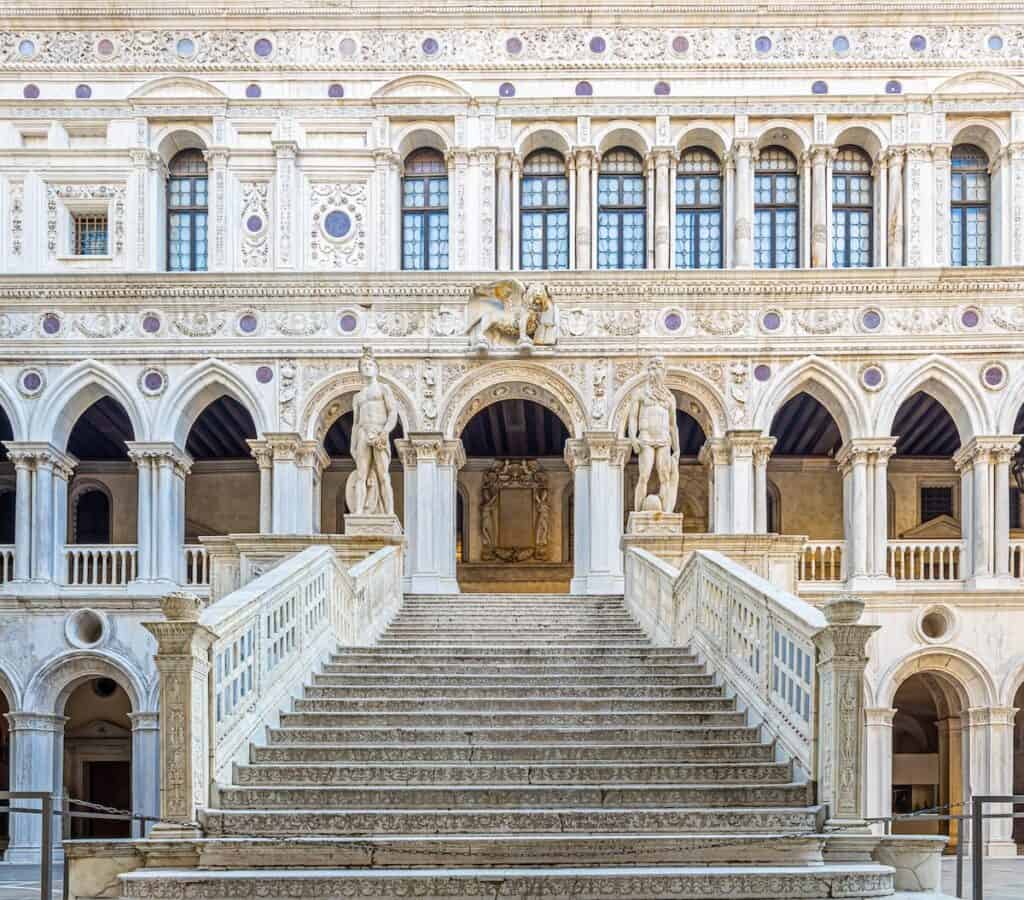
Upon entering the Courtyard from the oldest side facing the waterfront on the South, you will notice the Piazzetta wing of the Palace on the left and the Renaissance wing on the right.
The northern side of the courtyard is enclosed by the connection between the Palaco Ducale and St. Mark’s Basilica, formerly serving as the Doge’s chapel.
The courtyard’s main highlight is the Staircase of the Giants (Scala dei Giganti) located on the far right. This grand staircase was traditionally used for formal entrances and is flanked by Sansovino’s colossal statues of Mars and Neptune. These magnificent sculptures symbolize the power of Venice both on land and at sea.
To the right of the Giant’s Staircase is the Senator’s Courtyard. This is where the members of the Senate would gather before government meetings.
The arch opposite the staircase features alternating bands of white Istrian stone and red Verona marble, paying tribute to Doge Francesco Foscari. It serves as a magnificent pathway connecting the Giants’ Staircase to the Porta della Carta, now serving as the palace’s exit.
At the opposite end, the Censors’ Staircase will be your access to the loggia floor above.
The Loggias
The visit continues through the Renaissance wing, starting from the Censors’ Staircase and leading to the Gold Staircase.
Along the way, you’ll come across two noteworthy plaques. The first one, dating back to 1362, features elegant Gothic lettering from the time of Pope Urban V. It offers indulgences to those who provide charity to the incarcerated.
The second plaque, created by Alessandro Vittoria, stands near the Giants’ Staircase. It commemorates the visit of French King Henri III to Venice in 1574. You can better see it if you turn back at the end of the tour as you’re leaving through the Paper Gate.
Golden Staircase
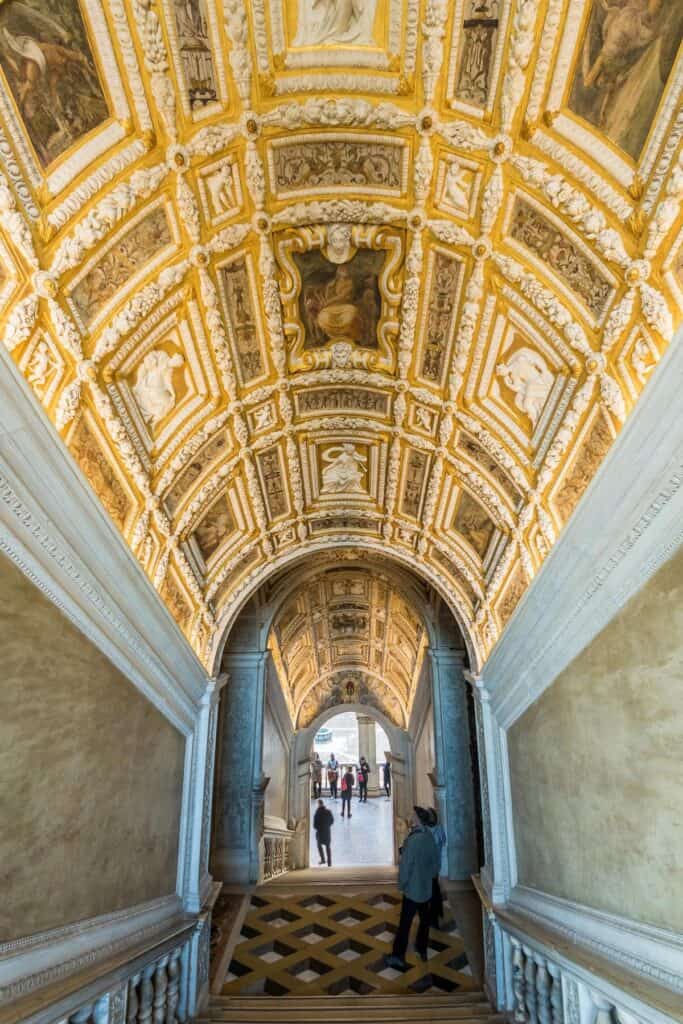
Golden Staircase (Scala d’Oro) is a very impressive ceremonial staircase decorated in real gold leading up from the loggias to Doge’s apartments and to the chambers of the state government.
Undoubtedly the most opulent staircase in the world, the Scala d’Oro owes its name to its rich decoration with white and gold stucco. The motifs showcase Venice’s dominance over the seas, its defense of Crete and Cyprus, and the virtues necessary for effective governance.
It is worth noting that the side walls of the staircase remain unadorned, not due to a lack of funds, but rather as a deliberate choice to create a contrast with the grandeur of the ceiling decorations.
This remarkable staircase offers two contrasting views: one reveals the majestic courtyard, while the other provides a glimpse of the Rio de la Canonica flowing beneath the Bridge of Sighs.
Doges’ Apartments (special tours only)
The Doge’s Apartments were historically situated in this wing of the Palace, but a devastating fire in 1483 led to its reconstruction in the Renaissance style.
The renovation during this period involved the remarkable refurbishment of the Doge’s Apartment, featuring intricately carved wooden ceilings, grand marble chimneys adorned with exquisite carvings, painted friezes, and stuccoes.
The core of the apartment served as a prestigious, albeit not overly spacious, residence. It was not uncommon for the Doge, prior to their election, to have a much larger and more opulent house with greater amenities than the one designated by the Republic.
In the private quarters, the furnishings were brought in from the Doge’s personal residence and, upon their passing, swiftly removed by their heirs to make room for the incoming Doge’s belongings.

Institutional Chambers
The Republic of Venice had a sophisticated government and judicial system, comprising numerous legal bodies and chambers, all housed in the Dodge’s Palace.
You will need at least some understanding of how the Republic of Venice was organized and its history to fully appreciate these chambers so make sure you don’t skip this chapter towards the end of this article.
The tour of the Institutional Chambers in the Palace commences in the Square Atrium. As you journey through the chambers, you will encounter the halls of the primary governing bodies. Additionally, you will explore the chambers utilized by the major judicial institutions within the Venetian Republic.
Every room is adorned with carefully selected decor, symbolizing not only the purpose of the bodies that convened within but also honoring the virtues of the State.
There are too many chambers to list here, but below you’ll find a guide to the most impressive ones.

Chamber of the Great Council (1st floor)
With dimensions of 53 meters in length and 25 meters in width, the Chamber of the Great Council is not only the largest and most grandiose in the Doge’s Palace, but also one of the biggest rooms in all of Europe.
The Chamber of the Great Council served as the venue for the Great Council meetings. Given that the Council was comprised of up to 2000 noblemen, it is clear that they required ample space to accommodate their meetings.
The Great Council, an ancient and important political body in the Republic, consisted of all adult male members of patrician Venetian families, regardless of individual status, or wealth. The Council was regarded as a symbol of republican equality. It had the power to hold other authorities accountable and ensure their powers remained in check.
The Council was also involved in the first phases of the election of a new Doge, which in the later stages would pass into the Sala dello Scrutinio.
The chamber is adorned with Venetian historical episodes, showcasing the city’s relations with the papacy and the Holy Roman Empire. The ceiling features an allegorical glorification of the Republic.
The longest canvas painting in the world, Tintoretto’s Paradiso, adorns one of the long walls, replacing a damaged Guariento fresco.
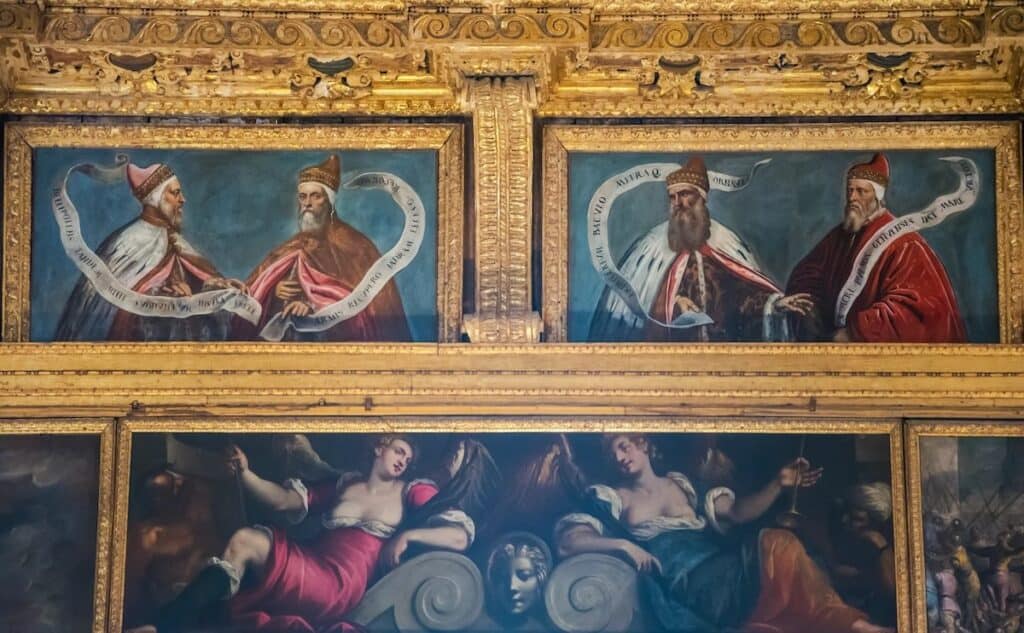
Portraits immortalize the first 76 doges, mostly painted by Domenico Tintoretto. Each doge holds a scroll highlighting their significant achievements.
You’ll notice a black cloth. This is to replace Doge Marin Faliero who attempted dictatorship. He was sentenced to death and damnatio memoriae, a total eradication of his name and memory.
The Chamber of the Scrutinio (1st floor)
The Chamber of the Scrutinio is located in the same wing as the Chamber of the Great Council. Originally named the Library, this chamber was designed to house the valuable manuscripts donated to the Republic by Petrarch and Bessarione.
However, in 1532, it was repurposed to accommodate electoral counting and deliberations, which played a crucial role in Venetian politics. With the construction of Sansovino’s Library, this room was exclusively used for elections, starting with the significant election of the Doge.
The present decorations in this location date back to the late 16th and early 17th centuries, created after the fire.
The ceiling, designed by Cristoforo Sorte, depicts military history scenes, highlighting Venetian conquests and victories. Notable paintings include The Battle of Lepanto by Andrea Vicentino, The Venetian Victory over the Turks at the Dardanelles by Pietro Liberi, and The Venetian Victory over the Turks in Albania by Pietro Bellotti.
The walls also depict battles won between 809 and 1656, including The Conquest of Tyre by Antonio Aliense and The Venetian Naval Victory over the Egyptians at Jaffa by Sante Peranda.
The Doges portraits continue in the frieze beneath the ceiling, accompanied by the Last Judgment by Jacopo Palma Giovane on the south wall. The room is completed by a majestic triumphal arch, dedicated to Doge Francesco Morosini Peloponnesiaco, who passed away during the Morea war.
Senate Hall (2nd floor)
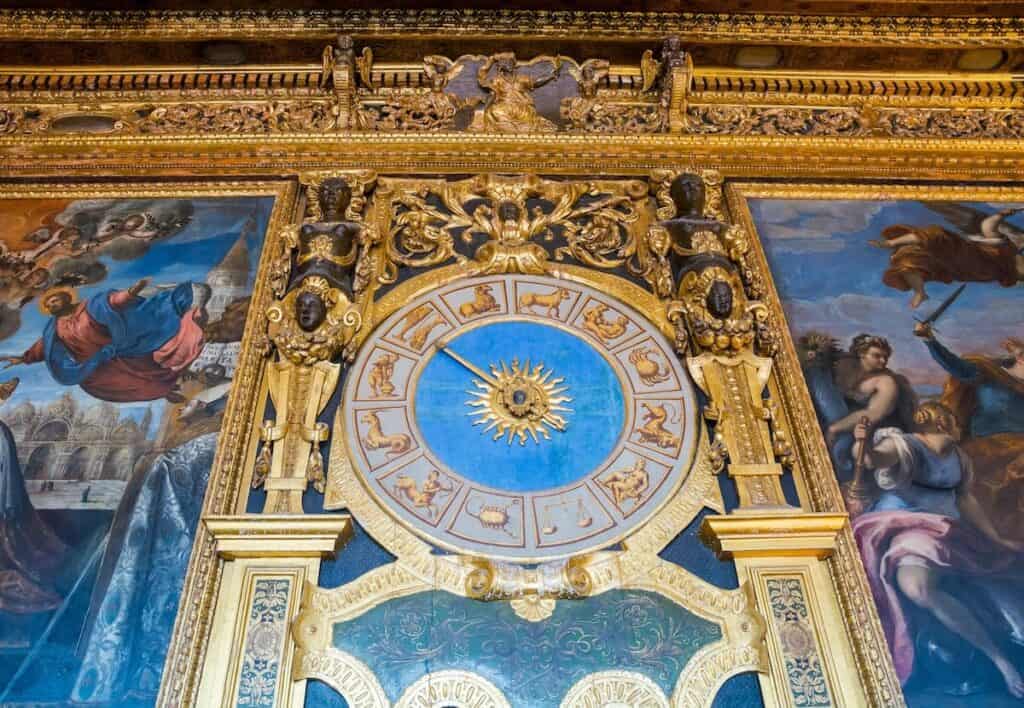
The Senate Chamber, or Sala dei Pregadi, was where the Doge requested Senate members’ attendance at meetings. Established in the 13th century, the Senate was one of Venice’s oldest public institutions. It later became responsible for overseeing political, financial, and trade matters and it functioned as a sub-committee of the Great Council.
Following the 1574 fire, the Chamber underwent extensive renovations. Tintoretto’s masterpieces in this room showcase Christ as the central figure, potentially symbolizing the Senate’s crucial role in the election of the Doge, who was believed to be divinely protected.
Furthermore, the room boasts four paintings by Jacopo Palma il Giovane, each intricately depicting significant events from Venetian history.
The Council Chamber (2nd floor)
The Full Council consisted of two separate and independent organs of power: the Savi and the Signoria.
The Savi were divided into the Savi del Consiglio, focusing on foreign policy; the Savi di Terraferma, handling Venice’s empire in mainland Italy; and the Savi agli Ordini, dealing with maritime issues.
The Signoria included the three Heads of the Councils of Forty and members of the Minor Council, which consisted of the Doge and six councilors, one for each district of Venice.
The Full Council organized and coordinated the Senate’s work, including reading dispatches, receiving delegations, and promoting political and legislative activities. It served as a guiding intelligence for the Senate, particularly in foreign affairs.
This chamber’s decor was designed by Andrea Palladio to replace what was destroyed in the 1574 fire. The wood paneling, carved ceiling, and splendid paintings were done by Francesco Bello, Andrea da Faenza, and Veronese respectively.
The ceiling is a masterpiece celebrating the Good Government of the Republic, with virtues of government depicted in smaller panels. There is also a large canvas by Veronese celebrating the Christian fleet’s victory at the Battle of Lepanto. Other paintings by Tintoretto depict various Doges with Christ, the Virgin, and saints.

Bridge of Sighs
The Bridge of Sighs, designed by Antonio Contino in 1614, connects the Doge’s Palace to the New Prisons. It has two enclosed corridors running parallel to each other.
One corridor links the Prisons to the Magistrato alle Leggi and Quarantia Criminal chambers, while the other connects the prisons to the State Advocacy rooms and the Parlatorio.
Both corridors are connected to a service staircase leading from the ground floor cells of the Pozzi to the roof cells of the Piombi.
The name of the famous bridge comes from the Romantic period. It was called the Bridge of Sighs because prisoners would sigh as they looked out at the lagoon and San Giorgio before going to their cells. Or at least, Lord Byron used this name in his poem in 1812.
The Bridge of Sighs is now a symbol of Venice and a beautiful reminder of the city’s history. You can see it from Riva degli Schiavoni or take a gondola ride underneath. Legend says that couples who kiss under the bridge will have eternal love.
Armoury
The Armoury houses a historical collection of weapons and armaments from various sources. The collection’s core dates back to the 14th century.
During the Republic, the Armoury, controlled by the Council of Ten, housed weapons for the Palace’s guards. On significant occasions, the arsenalotti, skilled workers from the Arsenale shipyards, would join the guards to provide additional security.
Today the collection contains over 2000 exhibits, including famous suits of armor, swords, crossbows, and Turkish pieces taken from enemies. The collection also features firearms, implements of torture, a chastity belt, and prohibited weapons.

Prison Cells
The Doge’s Palace also housed prisons dating back to the 12th century. The prisons in Doge’s Palace consist of the Piombi (Leads), the Pozzi (Pitts), and later the Prigioni Nuove (New Prisons) located across the iconic Bridge of Sights.
The conditions within the prisons were dreadful, and only a handful of those who entered would ever experience freedom again.
The Piombi, also known as the Leads, were cells situated directly beneath the roof, resulting in sweltering heat during summer and freezing cold during winter. The Pozzi, or Pits, are damp, cramped, and dimly lit cells (holes, really) on the ground floor.
In the 16th century, the New Prisons were built across the canal connected to the palace by the Bridge of Sighs. While conditions in the New Prisons were somewhat improved, they remained harsh.
The Prisons of the Palazzo were nearly impossible to escape, but the famous womanizer, Giacamo Casanova, managed to climb onto the roof of the palace and escape in 1756.
Paper Gate
The Paper Gate (Porta della Carta) functioned as the primary entrance to the Palace. Today, you exit the Palace through this gate. This grand entrance is the meeting point between St. Mark’s Basilica and the Doge’s Palace, best observed from St. Mark’s Square.
This impressive monument served as the entrance for dignitaries and ambassadors visiting Venice. The Porta della Carta also served as the starting point for processions, further emphasizing the Republic of Venice’s authority.
The Porta della Carta, originally called the Golden Gate, was constructed by Doge Francesco Foscari to flaunt his power and vanity and adorned with gold-covered sculptures.
The primary sculptures consist of four statues representing Fortitude, Prudence, Hope, and Charity, symbolizing the qualities of a good government. At the pinnacle stands the statue of Justice. Within the roundel, there is a bust of San Marco. Above the door, Saint Mark is symbolically depicted as a lion, with Doge Foscari kneeling before him.
This sculpture symbolizes the concept that even the powerful doge must submit to the state’s authority. But it’s worth noting that despite kneeling, the doge stands tall, with his head at the same height as the lion. The sculpture was destroyed by the French during their invasion of Venice in 1797 and the one at display now is a replica.

The Facade
The Palazzo Ducale is an elegant Gothic-style palace with some influences from oriental architecture, likely due to Venetians’ commercial contacts. You can admire the two main facades from the Piazzetta and the waterfront.
The Palazzo Ducale has beautiful bass reliefs on the basin facade created by Filippo Calendario. Adam and Eve are depicted on the left corner, with Archangel Michael above them. On the right corner, towards the Bridge of Sighs, there is a depiction of the drunkenness of Noah, with Archangel Raphael above.
The central balcony of the Great Council Hall overlooking the lagoon features 6 statues, including San Teodoro, San Giorgio, Temperance, Justice, Fortitude, Prudence, Charity, Faith, and Hope. On top, there is the lion of San Marco, along with statues of San Marco, San Pietro, and Paolo.
The Piazetta side features the Judgment of Solomon and the Archangel Gabriel to the left of the Porta della Carta. The central balcony features Mars, Neptune, Fame, Mercury, Jupiter, Doge Andrea Gritti, and a lion. On top, there is a statue of Venice. To the right, there is a bass relief depicting Justice.
The Palazzo Ducale in Venice has two red columns that stand out from the rest. These columns were used for pronouncing death sentences, with commoners executed in the Piazzetta and aristocrats hanged between the red columns. The condemned were left hanging for several days as a public display.
Every capital of each column is unique, encapsulating historical, moral, and political lessons. The artwork encompasses a wide range of subjects, including animals, human faces, angels, zodiac signs, symbols, allegories, and more.
Some of the original capitals have been replaced with replicas, while the authentic pieces are now safeguarded at the Museo dell’Opera in the Doge’s Palace.
History of the Palazzo Ducale
This site had a 9th-century fort of Byzantine origin, strategically located at the point of sea access. Over the years, it transformed into a palace, expanded, and underwent renovations and expansions. Destructive fires caused damage, but the main structure was preserved.
The palace was restructured several times, resulting in beautiful additions like the Stairs of the Giants and the Bridge of Sighs. The Palace was remodeled in the 18th century to house administrative offices and it finally became a museum in 1923.
Government Structure in the Republic of Venice
Venice had no written constitution but followed an Oath of Office for the Doge. It codified laws in five books of statutes and additional volumes on maritime law. The government consisted of:
- Doge: Head of state and all government institutions
- Collegio: Executive arm of government, including Savi Grandi and the Doge
- Minor Consiglio (Minor or Ducal Council): 6 members overseeing the actions of the Doge with veto power
- Consiglio dei Pregadi (Senate): Senate consisting of 120 members responsible for day-to-day legislation, including the Council of Ten and the Zonta
- Maggior Consiglio (Great Council): All adult male members of patrician Venetian families
Each committee or council was checked by another to ensure the rule of law. For instance, the Doge could be prosecuted (and was executed in at least one case), and the State Attorneys had the power to prosecute any official.
Dodge’s election process
Campaigning for office was prohibited. Instead, individuals could be elected without running for office and were obliged to serve if chosen – whether they liked it or not. This seemingly peculiar approach aimed to prevent the existence of ambitious politicians. The Venetians implemented multiple stages of random and election processes to create an incorruptible system (thanks to randomness) while striving for the highest quality (through democratic selection of the best). While the process evolved over time, here’s a rough breakdown:
- Randomly select 30 members from the Great Council
- Randomly reduce the 30 to 9.
- The 9 members nominate 40 candidates.
- Randomly reduce the 40 to 12.
- The 12 members nominate 25 candidates.
- Randomly reduce the 25 to 9.
- The 9 members nominate 45 candidates.
- Randomly reduce the 45 to 11.
- The 11 members nominate 41 candidates (aged 40 or above).
- The 41 members nominate one candidate each.
- The 41 members elect the Doge from the nominees through range 3 voting.
- The choice of the Doge is subject to approval or veto by the General Assembly.
In this process, only the second-to-last step, the election, truly mattered. The preceding steps were designed to make the identity of the 41 unpredictable, aiming to ensure an incorruptible process.
During their deliberations, the 41 members were secluded, in an effort to shield them from corruption. The 41 members employed “range3” voting (-1, 0, +1) to elect the Doge. A supermajority requirement was in place: the winner needed to obtain at least 25 points, exceeding a simple majority of 21.
If the 25-approval threshold was not achieved, the 41 members continued deliberations and held re-votes. In at least one instance, a deadlock occurred, which was resolved by a coin flip.
The Dodge held the position for life once elected.
Where to stay in Venice
If it’s your first time in Venice, San Marco is the best place to stay. This district is central and close to most of the major attractions. You’ll be right in the heart of the action with all the Venice things to do at your doorstep.
For a more authentic Italian experience or if you’re a returning visitor, consider staying in Cannaregio or Dorsoduro. These areas are less touristy, more affordable, and offer a true taste of Venetian life.
Rosa Salva Hotel | AFFORDABLE & CENTRAL
This beautifully renovated hotel is both spacious and comfortable. It offers a great price for such a central location.
Palazzo Pianca | MODERN MEETS HISTORY
Enjoy modern design with nods to Venetian art and history. This hotel is central and very comfortable.
Baglioni Hotel Luna | CENTRAL AND LUXURIOUS
Expect incredible views over the Grand Canal, impeccable service, and breathtaking interiors. For those who want to indulge in luxury.
Are you planning a trip to Venice?
With its romantic canals, red rooftops, and gorgeous Mediterranean views, Venice is a dream come true and a once-in-a-lifetime trip for many, worth a little extra planning.
Before you head off, make sure to check out our Venice travel guide!

Hidden gems of Venice – 30-ish unusual things to do in Venice


Venice in Winter – 30+ best things to do in winter in Venice

One Day in Venice Itinerary – How to spend 24h in Venice, Italy

Dolomites day trip from Venice – what to see, do and best tours


St. Mark’s Basilica – Your guide to the majestic Venice Cathedral

Where to stay in Venice – the best (and worst) areas in Venice