20 Unforgettable things to do in Lecce, Puglia

If you’re looking for the best things to do in Lecce, this city delivers a lot more than a quick Baroque photo stop.
Lecce is one of the most rewarding places to visit in Puglia because you get the big hitters like ornate churches, Roman ruins, elegant piazzas, and excellent food, but also plenty of smaller surprises that give the city real character.
.
I’ve pulled together this guide to the best things to do in Lecce with a mix of must-see landmarks, genuinely worthwhile local experiences, and a few offbeat additions that many lists gloss over.
So yes, you’ll find the headline sights like Basilica di Santa Croce, Piazza del Duomo, and the Roman amphitheatre. But you’ll also get the kind of ideas that make your time here feel more rounded; from taking a walking tour or food tour to finding Lecce’s artisan side and choosing the right day trip.
It’s compact, easy to explore, and dangerously good at turning a “we’ll just stay one night” stop into a longer stay. Let’s get into the very best things to do in Lecce — and which ones are actually worth your time.

In a hurry?
Lock in your key Lecce tours and day trips early. The best small-group tours fill up fast!
🛏️ Stay at: Palazzo Dei Dondoli
Why Visit Lecce
Lecce is one of the easiest cities in Puglia to love. It ha grand Baroque architecture, Roman leftovers, excellent food, and just enough grit to stop it feeling like an over-polished postcard.
Lecce is compact, atmospheric, and genuinely fun to explore.
What makes it work so well is the balance. You can spend your morning ducking between ornate churches and quiet lanes, break for a pasticciotto and a caffè leccese, then head out to the coast or nearby towns without needing a military-grade itinerary.
It’s also a great base. If you want somewhere that gives you a proper city feel but still makes day trips to Otranto, Gallipoli, and the Valle d’Itria easy and doable.
Where to Stay in Lecce
Lecce is easiest if you stay either inside or just beside the centro storico for atmosphere or closer to the station for convenience.
The old town is compact enough that you won’t spend half your trip commuting, but location still matters if you’re planning day trips, early trains, or late dinners that turn into one more glass of wine.
La Fiermontina — LUXURY BOUTIQUE STAY
A polished, design-forward stay with a calm, tucked-away feel just outside the old town. Best if you want a quieter, high-end base that still keeps Lecce’s main sights within easy reach.
Patria Palace Hotel Lecce — ICONIC CENTRAL SPLURGE
Right by Santa Croce, this is the one to book if you want classic elegance and a location that puts you in the middle of Lecce’s Baroque core.
Palazzo Dei Dondoli — CHARMING VALUE PICK
A smaller, characterful stay that works well if you want something more affordable and low-key without being stranded miles from the center.

20 Unforgettable Things to Do in Lecce
There are plenty of things to do in Lecce, but this isn’t a city you should attack like a checklist. The big sights matter, obviously, but Lecce is at its best when you mix the headline attractions with food stops, small museums, artisan traditions, and at least one day trip that gets you out into the rest of Salento.
In this guide I cover the full spread: the Baroque heavy-hitters, the Roman layer underneath, the local specialties, and a few offbeat picks that stop your itinerary feeling like church, church, eat, repeat. Which, to be fair, would still be a decent day.

Take a walking tour of Lecce
This walking tour is one of the best first things to do in Lecce. The historic center is compact, but it’s full of easy-to-miss details and this walking tour will ensure you don’t miss anything.
Streets bend unexpectedly, courtyards hide behind plain doorways, and some of the most interesting stories are tied to buildings you’d otherwise walk right past.
What makes Lecce stand out is pietra leccese, the local limestone used across the city. It’s relatively soft when quarried, which made it ideal for carving. That’s a big reason Lecce’s Baroque architecture is so wildly detailed. Sculptors could go all in, and clearly they did.
A good tour helps you notice things like:
- carved balconies and family crests
- hidden Roman traces
- local symbols and stone creatures
- the contrast between noble palaces and everyday streets
If you want a classic city intro, book this guided walking tour. It is a strong choice if you want the architecture, history, and layout of the old town explained properly.
If you’d rather combine sightseeing with snacks, book this history and food tasting tour. It works especially well on your first day, when you want both context and a few excellent reasons to stop walking.
If you want something more niche, this tour includes a visit to the Jewish Sunagogue. That gives you a more layered view of the city beyond the headline Baroque sights.

Stop at Piazza del Duomo
Piazza del Duomo is one of Lecce’s most beautiful spaces, and part of what makes it memorable is the reveal. It’s not wide open like most big Italian piazzas. You turn a corner and suddenly you’re in it.
The square feels unusually cohesive because it was designed as a ceremonial religious space. You’ve got the cathedral, bell tower, bishop’s palace, and seminary all facing into the same enclosed setting. It feels grand, but not sprawling.
A few things make it stand out:
- it’s partly enclosed, which gives it a more intimate feel
- the architecture is carefully staged, almost theatrical
- the stone glows beautifully in late afternoon light
One detail to watch for is the cathedral’s unusual orientation. Its main facade was designed to face into the square rather than toward the usual street approach. That tells you a lot about how this piazza was meant to be experienced.
If you can, come back twice. Once during the day to take in the architecture, and again in the early evening when the square starts looking smugly perfect.

Visit Lecce Cathedral and the crypt
Lecce Cathedral is one of the city’s major Baroque landmarks, and it’s worth going inside. The exterior is elegant, but the interior gives you the full Lecce treatment with ornate chapels, decorative ceilings, and a strong sense of ceremony.
The current cathedral was largely rebuilt in the 17th century under Bishop Luigi Pappacoda, with work by Giuseppe Zimbalo, one of the key architects behind Lecce’s Baroque look. Once you start spotting his influence around town, the city feels much more connected.
The crypt feels older, quieter, and more atmospheric than the church above. While the main cathedral leans theatrical, the crypt feels grounded and a little more mysterious.
It’s a good reminder that Lecce wasn’t built in one neat phase. Like most Italian cities with any self-respect, it’s layered.
Climb the bell tower for the best views in Lecce
The bell tower in Piazza del Duomo is one of the best things to do in Lecce if you want to see how the city actually fits together. From street level, Lecce can feel like a maze of honey-colored lanes and ornate facades. From above, you get the full picture.
The campanile rises to around 72 metres, which makes it one of the tallest bell towers in the region. It was built in the 17th century and, like the cathedral, is tied to the Baroque transformation of Lecce under Bishop Luigi Pappacoda.
On a clear day, the view really helps you understand Lecce’s setting in the wider Salento plain. It also gives you a break from staring up at facades and lets the city unfold in one sweep.
A few things to keep in mind:
- go earlier or later in the day if you want softer light
- do it after exploring the piazza below, so the view means more
- a panoramic lift will take you to the viewing balcony at the 43-meter level
Lecce is gorgeous at eye level. From above, it looks even better!

Take a food tour in Lecce
A food tour is one of the smartest ways to get to know Lecce.You are not just eating your way around town. You’re learning what matters locally, where certain dishes come from, and how Salento’s food culture differs from the rest of Puglia.
A good food tour also gives you context on cucina povera, the traditional cooking style shaped by seasonality, agriculture, and making humble ingredients work hard. In Salento, that often means simple dishes with strong flavors and zero interest in showing off.
Some of the best things to try include:
- puccia, the chewy local sandwich bread, often filled with cured meats, cheese, grilled vegetables, or (my favorite) octopus.
- rustico leccese, a flaky pastry filled with béchamel, tomato, and mozzarella
- pizzi, soft tomato-topped buns that are simple but dangerously easy to keep eating
- taralli, the addictive ring-shaped snacks that show up everywhere and disappear fast
- friselline and other small bakery bites that are perfect with an aperitivo
- pasticciotto, the classic pastry filled with crema.di vanilla
Book this Lecce history & food tour if you want a strong mix of local storytelling and tastings. It’s one of the easiest ways to make your first day in Lecce both fun and actually informative.
If you want a more casual, snack-heavy experience, book this street food tour. This is a good choice if you want to focus more on local bites and less on full-on sightseeing.
And if you want to lean into the drinks side too, book this wine experience. It is a nice add-on if you already have the main sights covered and want something more focused.

Admire the elaborate details at the Basilica di Santa Croce
The Basilica di Santa Croce is Lecce’s great Baroque showpiece. If you only study one facade in town properly, make it this one.
Construction stretched over a long period, roughly from the 16th to the 17th century, which helps explain why the facade feels so layered. And yet it still works as a whole. Barely restrained is probably the best description.
This is the building to linger over because the detail is ridiculous in the best way. Look for:
- cherubs and floral carvings
- mythical figures and animals
- twisting columns and decorative excess
- the huge rose window framed by intricate stonework
The local limestone made this kind of decoration possible. Pietra leccese was soft enough to carve in extraordinary detail, which is why the facade looks almost embroidered in places.
There are also lots of interpretations attached to the symbolism on the front. Some carvings have religious meaning, some likely signal status or power, and some seem to exist because the sculptors had talent and absolutely no interest in keeping things minimal.
The best approach is simple:
- stand close and study the lower details first
- then step back and scan upward slowly
- do not just take one photo and move on
Santa Croce rewards patience. It’s basically a stone puzzle designed by people who thought subtlety was for other cities.

Join a cooking class
A cooking class is one of the best hands-on experiences in Lecce. It breaks up the churches and museums nicely, and it gives you something more memorable than just another plate of pasta you forgot five days later.
Most classes focus on fresh pasta, which makes sense in this part of Puglia. The point is not to produce restaurant-perfect food. It’s to understand the techniques, textures, and simple ingredient logic behind local cooking.
What makes these classes worthwhile is the extra context. You usually get more than a recipe. You get the small household details that matter, like how dough should feel, why certain shapes are made by hand, and why sauces are often kept simple on purpose.
Expect a class to include:
- hands-on pasta shaping
- local ingredients and cooking tips
- wine and a meal at the end
- stories about Salento food traditions
It’s also a genuinely good couple activity. You’re doing something interactive, useful, and relaxed, which is a lot better than pretending you both enjoy reading every museum panel.
Book this cooking class if you want the strongest hands-on food experience in Lecce. The wine tasting helps, obviously, but the real value is learning techniques and recipes you’ll actually remember.

See the Roman amphitheatre
The Roman amphitheatre is one of Lecce’s clearest reminders that the city did not begin with Baroque churches and polished piazzas. Parts of it date to the 2nd century AD, when ancient Lupiae was an important Roman center in this part of southern Italy.
It is not the grandest Roman site in Italy, but it does not need to be. Its real charm is how casually it sits inside the modern city.
Only part of the amphitheatre is visible today, which honestly makes it more interesting. The rest still lies buried under the modern square and surrounding buildings.
That overlap is part of what makes Lecce so good. The city does not separate its history neatly. It just stacks new life on top of old stone and carries on.

Spend time in Piazza Sant’Oronzo
Piazza Sant’Oronzo is Lecce’s main civic square and one of the best places to get a feel for the city beyond the obvious postcard spots. It is busy, layered, slightly uneven in places, and much more representative of real Lecce than a perfectly staged corner of the old town.
This square pulls together several different eras at once. You have the Roman amphitheatre, later palaces, modern shops, cafés, and the column topped by Sant’Oronzo, the city’s patron saint.
According to local tradition, Sant’Oronzo protected Lecce from plague, which is the kind of miracle that tends to secure long-term popularity. The column itself has an extra historical twist too. It is believed to be one of the two ancient Roman columns that once marked the end of the Appian Way in Brindisi.
Also look out for the Mosaico della Lupa set into the pavement. It shows Lecce’s coat of arms, a she-wolf beneath a holm oak, and it is one of those easy-to-miss details that gives the square a bit more character. Locals also attach a superstition to it, with some avoiding stepping directly on the wolf for fear of bad luck.
This is a good place to sit down for a few minutes rather than just passing through. Piazza del Duomo may be prettier, but Piazza Sant’Oronzo has more pulse.

Walk through Lecce’s three historic gates
Lecce’s three historic gates are easy to overlook if you are only moving between the headline sights, but they are well worth seeking out. They help you understand how the old city was once enclosed and give some structure to an otherwise free-form wander.
The three main gates are:
- Porta Napoli
- Porta Rudiae
- Porta San Biagio
Porta Napoli is the most monumental of the three. Built in the 16th century, it has the feel of a triumphal arch and was created in honor of Charles V. It is grand, formal, and clearly intended to impress anyone entering the city from that side.
Porta Rudiae is often the most atmospheric. It was rebuilt in the 18th century and marks the route toward ancient Rudiae, the old Messapian and Roman settlement outside Lecce. That connection matters because Rudiae is traditionally linked to the Roman poet Ennius, who famously described himself as having three hearts because he spoke Greek, Oscan, and Latin. A bit dramatic, but memorable.
Porta San Biagio is the southern gate and arguably the prettiest. It has more decorative detail and feels especially photogenic when you approach it from outside the center.
If you like wandering with a loose mission, walking between all three is a good one. It helps you see Lecce as more than a collection of beautiful facades.
Explore Lecce’s museums
Lecce’s museums explain the layers behind the city’s good looks. The architecture is what grabs you first, but the museums help fill in the Roman, medieval, Jewish, and everyday stories that shaped Lecce over time.
If you only visit one, make it Museo Faggiano. This is easily one of Lecce’s best small museums because the origin story is half the attraction.
A family was renovating their house when they uncovered archaeological remains beneath it, and the project turned into an accidental journey through centuries of local history. Instead of fixing plumbing and moving on like normal people, they ended up revealing tombs, storage pits, traces of earlier structures, and a much deeper story beneath the surface.
Other worthwhile options include the Jewish Museum of Lecce, which adds important context on the city’s Jewish heritage, and MUST, which brings in a broader cultural angle through historical and contemporary exhibitions.

Explore more beautiful churches
Lecce is full of churches, and after a while they can start blending together if you are not paying attention.
These two are worth singling out because they show different sides of the city’s Baroque style without feeling like repeats of Santa Croce or the cathedral.
Santa Chiara sits just off one of Lecce’s prettiest little squares and has a softer, more graceful feel than some of the city’s showier churches. The facade is elegant rather than overwhelming, and the setting helps. It is the kind of place that feels properly Lecce once you stop rushing and actually look around.
San Matteo is the more unusual one. Its facade curves outward slightly, which gives it a sense of movement that stands out straight away. It was inspired by Roman Baroque models, and you can feel that difference. It is more dramatic, a bit less restrained, and has the kind of front that makes you pause even if you had not planned to.

Order a caffè leccese and a pasticciotto
This is one of the most essential things to do in Lecce, and thankfully it is also one of the easiest.
Pasticciotto is Lecce’s signature pastry, traditionally filled with custard and baked until the shell is lightly golden and just crisp enough. It was created in the 18th century, and like many great food stories, it supposedly came from using leftover scraps of dough and custard.
Order the pasticciotto warm if possible and do not wait until late in the day, since the best trays go fast. Try the classic custard version first before getting fancy with fillings.
Caffè leccese is coffee served over ice with almond syrup. On paper, it sounds like it could be too sweet but in practice, it is excellent, especially when Lecce is hot enough to make you reconsider every life choice that involved walking around at noon.
If you want to try these with proper context rather than just guessing where to stop, book this food tour.

Take a day trip to Otranto and the Adriatic coast
If you only do one day trip from Lecce, make it Otranto and the Adriatic coast. It gives you a completely different side of Salento, with sea views, a compact old town, and a mood that feels brighter and breezier than Lecce’s warm-stone grandeur.
Otranto is one of Puglia’s most appealing coastal towns. It has a long, strategic history tied to trade, Ottoman invasion, and defense.
The real standout is the cathedral’s Tree of Life mosaic floor, one of the most unusual church interiors in southern Italy. It spreads biblical scenes, animals, symbols, and strange medieval imagery across the floor like a giant visual puzzle.
The wider Adriatic coast is part of the appeal too. This stretch of shoreline is known for dramatic scenery, clear water, and some of Salento’s most memorable coastal stops.
- Grotta della Poesia for its famous natural sea pool and swimming spot near Roca
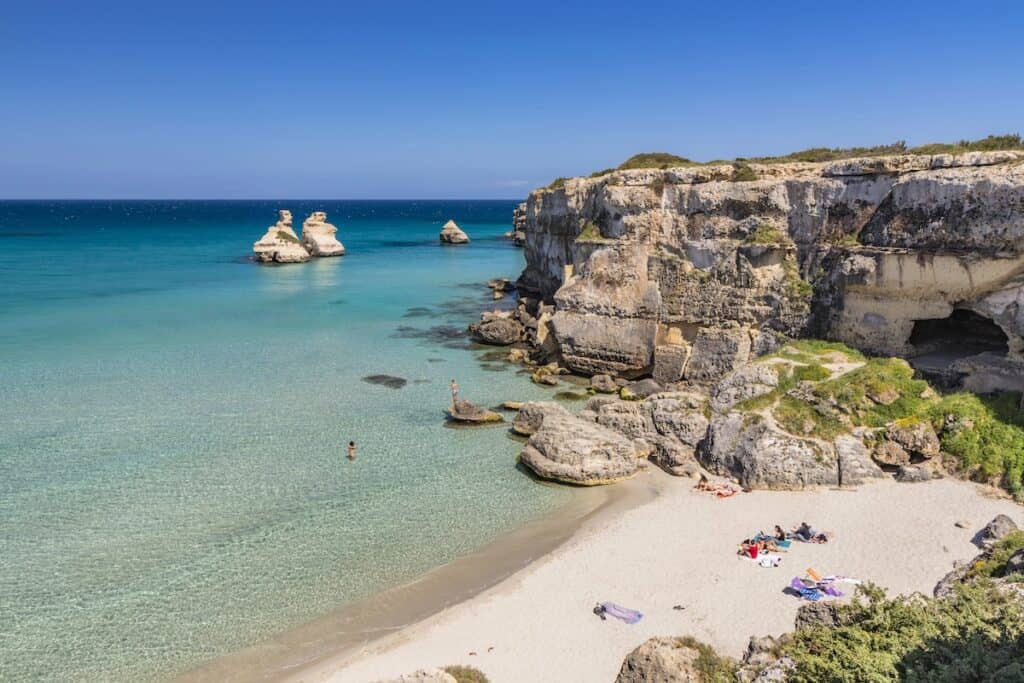
- Due Sorelle at Torre dell’Orso for the iconic twin sea stacks just offshore
- Sant’Andrea for its striking limestone cliffs, sea arches, and turquoise coves
If you want the easiest option, book this Otranto coast day trip. It is a strong pick if you want a mix of town and scenery without having to think about logistics.
For a slightly broader coastal day out, book this Otranto and Castro tour. That is a good choice if you want more sea views and a fuller taste of the Adriatic side of Salento.
If you want a broader look at the peninsula, book this Salento towns tour. It includes Otranto, Santa Maria di Leuca, Gallipoli, and Galatina, so it is a great option if you want to see more of Salento in one day without sorting out the logistics yourself.

Visit Gallipoli and the Ionian coast
For a different side of Salento, head to Gallipoli and the Ionian coast. This stretch feels softer and more beachy than the Adriatic, with calmer water, sandy shores, and a slower pace overall.
Gallipoli is the main draw. Its old town sits on an island linked to the mainland by a bridge, with narrow lanes, sea-facing walls, and a stronger maritime feel than Lecce.
It was also an important trading port, especially for lamp oil, which once made the town rich.
If you want a varied day out, book this Gallipoli, Galatina, beaches, and winery tour.
If you want a broader overview of the peninsula, book this Salento towns tour. It includes Otranto, Santa Maria di Leuca, Gallipoli, and Galatina.

Explore Valle d’Itria and Polignano a Mare
If you want a classic big-hitters day trip from Lecce, book this day tour from Lecce. You’ll get three of Puglia’s most famous places in one outing, which is efficient, scenic, and yes, a little ambitious. But if your time is limited, it works.
Ostuni is known as the White City because of its lime-washed buildings, which helped reflect heat and may also have had hygienic benefits in the past. The effect is striking, especially in bright light, with the whole place looking as if someone turned the contrast up too high.
Alberobello is the most unusual stop. Its trulli, the cone-roofed stone houses, were built using dry stone techniques and have become one of Puglia’s most recognizable sights. The area can feel very touristy, because of course it can, but it is still worth seeing at least once. There really is nowhere else quite like it.
Polignano a Mare gives the day trip a coastal finish. The town is famous for its cliffside setting, sea caves, and that postcard-ready beach tucked between rocky walls. It is also the birthplace of Domenico Modugno, the singer of “Volare,” which locals are understandably not shy about reminding you.
Discover Lecce’s papier-mâché tradition
One of the most distinctive local crafts in Lecce is cartapesta, the papier-mâché tradition that has been part of the city for centuries.
The tradition developed partly because papier-mâché was far cheaper than marble or wood for religious statues and decorative objects. Local artisans could create expressive, detailed figures using humble materials like paper, glue, straw, and wire. It was practical, but it also became an art form in its own right.
What makes it interesting is the contrast. Lecce is famous for stone, yet some of its most delicate religious art came from paper pulp and patience. That is a very Italian kind of logic. Grand result, modest materials.

Browse the monthly antiques market
If you happen to be in Lecce at the right time, the monthly antiques market on Viale XX Settembre is a fun detour from the standard old-town circuit. It adds a different side to the city and gives you a glimpse of local browsing culture that feels more everyday than polished.
Part of the charm is that it is never too polished. Some stalls are full of genuinely interesting finds. Others are closer to a rummage sale with better lighting. That unpredictability is half the appeal.
See Lecce’s alternative side at Manifatture Knos
If Lecce’s churches and Baroque facades are starting to feel a bit too polished, Manifatture Knos is a good change of pace. This former industrial space has been turned into a cultural hub with exhibitions, events, performances, and creative projects that show a different side of the city.
It is more raw and contemporary than the historic center, which is exactly the point. Lecce is not only carved stone and old palaces. It also has a younger, more experimental side, and this is one of the best places to see it.
This is a good pick if you like places with a bit of edge, or if you just want proof that Lecce has more going on than saints, stone cherubs, and pastry. Though to be fair, the pastry is doing excellent work.

Admire Lecce’s elegant palazzos and noble facades
Lecce’s Baroque beauty is not just about churches. Some of the city’s most striking details are on its palazzos, where aristocratic families showed off with carved balconies, grand portals, coats of arms, and all the decorative stonework the city does so well.
Some of the best Palazzos to look out for include:
- Palazzo dei Celestini, right beside Santa Croce, for its grand facade and sheer scale. It was once a convent complex and now houses provincial offices, which feels slightly less glamorous than its exterior suggests.
- Il Sedile, on Piazza Sant’Oronzo, for its distinctive open loggia and civic history. It is smaller than some of Lecce’s noble palaces, but it stands out because it was built as a public meeting place rather than a private residence.
- Palazzo Adorno, near Porta Napoli, for its richly decorated facade and elegant noble character. It is one of the best examples of how Lecce’s aristocratic architecture could be ornate without going fully off the rails.
- Palazzo Guarini, in the old town, for its elaborate balconies and decorative stone details. This is a good one to pause at if you want to see how much effort Lecce families put into making an entrance.
- Palazzo Marrese, for its theatrical facade and sculpted details that reward a slower look. It is the kind of building that reminds you Lecce’s Baroque style spilled well beyond its churches.
- Palazzo Taurino, in the former Jewish quarter, for its historic setting and the way it connects noble architecture with another layer of the city’s past. It is worth noticing as much for where it is as for the building itself.
- Palazzo Tamborino Cezzi, for its Liberty-style details and more unusual look compared with Lecce’s heavier Baroque facades. It stands out because it reflects a later architectural moment and shows the city did not stop evolving after its Baroque peak.
- The Seminary Palace in Piazza del Duomo, for the way it helps frame one of Lecce’s most beautiful squares. People tend to focus on the cathedral, but the palace is a big part of what gives the piazza its stately, balanced feel.

Getting to Lecce
Lecce is in southern Puglia, and while it feels a little tucked away on the heel of Italy, it is actually pretty straightforward to reach.
- By air: The closest airport is Brindisi Airport, around 45 minutes away by car and the most practical option for most trips. Bari Airport is another option, but transfers are longer.
- By train: Lecce is well connected by train, especially from Bari, Brindisi, and other cities in Puglia. You can also reach it from bigger hubs like Rome or Naples, though journeys are longer and may involve a change.
- By car: Driving gives you the most flexibility, especially if you want to explore Salento, beaches, and smaller towns beyond Lecce.
- By private transfer or tour: This makes the most sense if you are arriving late, carrying luggage, or planning to fold Lecce into a wider Puglia itinerary without dealing with logistics.
If you are only visiting Lecce itself, you do not need a car. If you want to use it as a base for the coast, wineries, and smaller towns, having one helps a lot.
Getting Around Lecce
Lecce is easy to get around, and for most visitors, walking is the main event.
- On foot: The historic center is compact and best explored slowly. Most of the main sights are close together, and wandering a bit is half the point.
- By bike: Useful if you are staying outside the center or want to cover more ground without driving.
- By car: Only really helpful for day trips. Inside Lecce, it is more hassle than help thanks to restricted traffic zones, narrow streets, and parking headaches.
- By taxi: Handy for station transfers, late arrivals, or getting back from a restaurant outside the center.
- By train or bus: Good for some day trips, though services can be slower and less convenient than driving.
For Lecce itself, keep it simple. Walk everywhere, stop often, and save the car energy for the wider Salento peninsula.

Where to Eat and Drink in Lecce
Lecce eats very well. You have classic Salento dishes, strong aperitivo options, good wine, and plenty of places where you can eat casually without feeling like you have settled. The trick is balancing old-town atmosphere with places that are actually worth your time.
- Boccon Divino for great-value dining with delicious food and excellent wine. It is in a touristy area, but the tourist menu is genuinely good value and actually very tasty, which is rarer than it should be.
- Caffè Alvino for classic Lecce people-watching right on Piazza Sant’Oronzo. Good for a coffee stop, a quick sugar hit, or a break in the middle of sightseeing.
- A local pasticciotto spot for breakfast or a snack because this is not the city to skip pastries. Go classic first.
- A traditional osteria for Salento dishes if you want something more local and substantial in the evening, especially for rustic pasta dishes, vegetables, legumes, and grilled meat.
- A wine bar in the old town for aperitivo because Lecce does early evening very well, especially when there is a cold glass of local wine involved.
Lecce is one of those places where it is worth mixing a few planned meals with spontaneous stops. Some of the best moments are still just good wine, warm stone, and whatever looked right on the menu five minutes ago.
Is Lecce Worth Visiting?
Lecce is worth visiting if you want a city that feels beautiful but still livable, historic but not stiff, and full of character without needing a massive checklist of blockbuster sights.
Visit Lecce for:
- standout Baroque architecture
- Roman ruins right in the middle of town
- genuinely good food and local specialties
- easy access to both the Adriatic and Ionian coasts
- a compact center that is enjoyable to explore
It also works well on different kinds of trips. Lecce can be a city break, a base for Salento day trips, or part of a wider Puglia itinerary. That flexibility is a big part of its appeal.
If you like places with detail, texture, and a bit of life beyond the polished surface, Lecce delivers.

Best Time to Visit Lecce
The best time to visit Lecce is usually spring or early autumn.
Spring is one of the nicest times to be here. The weather is usually warm but manageable, the city feels lively, and you can sightsee without melting into the pavement.
September and early October are also excellent. It is still warm enough for day trips to the coast, but the pace is slightly calmer than peak summer.
Summer is popular for a reason. Lecce looks great, the evenings are lively, and the coast is at its best. But it can get very hot, especially in July and August, and midday sightseeing can feel like a tactical error.
Winter is quieter and cheaper, and Lecce still has charm, but it is less energetic and not ideal if you are hoping to combine the city with beach time.
For most people, May, June, September, and early October hit the sweet spot.
Lecce FAQ
How many days do you need in Lecce?
Two to three days is a good amount of time for Lecce. That gives you time to see the main sights, eat properly, and fit in at least one day trip.
Is Lecce walkable?
Yes. Lecce is very walkable, especially in the historic center.
Do you need a car in Lecce?
Not for the city itself. For day trips around Salento, a car can be useful, though guided tours are an easy alternative.
Is Lecce expensive?
Lecce is not the cheapest place in Puglia, but it is usually more manageable than bigger Italian city destinations. You can still eat well and stay well without going fully off-budget.
What is Lecce best known for?
Lecce is best known for its Baroque architecture, pietra leccese stone, Roman remains, and local specialties like pasticciotto and caffè leccese.
Is Lecce a good base for Puglia?
Yes, especially for exploring Salento. It works particularly well for day trips to Otranto, Gallipoli, Santa Maria di Leuca, and smaller towns across the peninsula.
When should you avoid Lecce?
If you hate heat and crowds, late July and August may test your patience. The city is still worth it, but you will need to plan around the hottest part of the day.
Are you planning a trip to Puglia?
Puglia looks easy on a map, but it’s bigger, more spread out, and more varied than many people expect. Where you stay, how you get around, and which towns you prioritize can make a huge difference to your trip.
Before you book anything, check out all our Puglia guides and itineraries too.